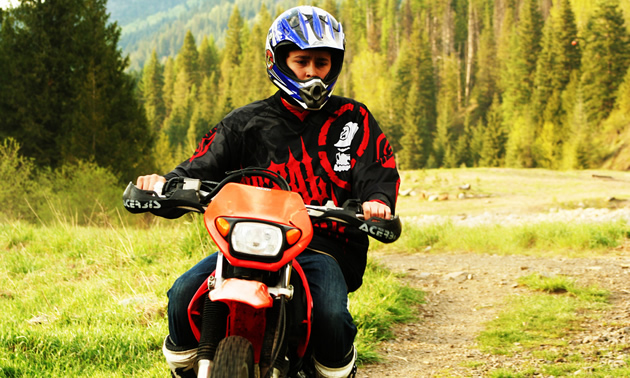
All units have a specific vibe when they are running in optimum condition. Know your unit. Seat time naturally builds an intimate relationship that will prove invaluable in the duration of your ownership.
Feel
Vibration can indicate many potential issues:
1. Check tire pressure. Are your tires balanced? Are your tires inflated to the recommended psi? Over-inflated tires can result in limited traction and they have the potential to puncture more easily, while under-inflated tires can result in poor handling, loss of fuel economy, and more serious, a complete loss of control of the unit. This happens most often on an ATV or UTV where the tire rolls under the rim. For ATVs, if units are stored in cold temperatures for a long time they can develop a flat spot in the tire. Be aware of this.
2. Chain tension and condition. To identify the optimum chain tension you need to first identify if there is a tight spot. To do this, you spin the wheel and measure the chain tension in a variety of increments. If you find a tight spot, adjust your chain from there. Tighten it to the manufacturer’s specification. If you have your chain too tight you can take out an entire transmission; if it’s too loose, it can wreak havoc with your bike.
3. Worn bearings may also be a cause for vibration. Inspect your seals and bearings for signs of wear and excessive play.
4. Vibrations and rumbles could all indicate deeper, more serious engine problems. By paying attention to subtle clues, such as vibrations, you could save big bucks in the long run, as you prevent massive damage from occurring.
Smell
If you smell burnt toast—go to the hospital. If you smell burning wires or plastic, it could indicate a variety of problems.
1. Short circuit—you will smell smoke. Stop—or if this is the case, you probably will have come to an abrupt halt anyway.
2. The smell of burning plastic usually indicates that your exhaust is in contact with your plastic gear or clothing. Stop and inspect your exhaust when it has cooled down—not when the pipe is still hot or the next smell will be the smell of burnt flesh or gloves.
3. The smell of maple cookies indicates a coolant issue. Your bike may be overheating or overworked.
Sight
Have your lights burnt out? If more than one light burns out, it could be a faulty charging system—if not, replace your bulb.
Watch your buddies' bikes and let them know if they are yard-saling parts all over the road. Do you see smoke coming out of your buddy’s exhaust? He will most likely feel something is off at this point, but you can confirm that his bike is spewing plumes of smoke—so perhaps it’s time to change his plug. After you are done riding, like we have impressed time and time again, clean your ride and inspect it for everything.
Do you hear what I hear?
Never is it recommended to use devices such as iPods or MP3 players when out riding. Not only can it prove to be hazardous when you are unable to hear other riders around you, but you can miss important clues that your bike, ATV or UTV could be trying to share with you.
Shifting gears
Newbies often don’t know when to shift gears. Listen to your r.p.m.'s to determine when to shift. If your bike or ATV is lugging and chugging, shift it down; if it sounds like a chainsaw, shift up. After a while, it will become intuitive, but until then listen and learn.
If your r.p.m's are high and your drive is low, a few situations may be in the works. You may have a slipping clutch, oil level could be low or a tire could be flat and spinning on the rim. For units with belts, if you experience this, your belt may be slipping.
Knock, knock
The sound of knocking in your engine is never good a good thing. Shut ’er down, my friend. It could also be time to tear it down. Knocking engine—yup, it just may be knocking on heaven's door.
All that being said, there are some idiosyncrasies with each bike; some bikes just naturally sound loud and clunky. Time after time, people will insist that there is a funny noise coming from their unit, only to discover that it’s supposed to sound like that. Compare your bike or ATV to one that has been broken in properly to develop a reference point for optimum performance. A new bike will never sound, feel or handle the same as one that has been broken in. Sometimes there are governing factors set from the manufacturer preventing that unit to be held wide open. Always follow the manufacturer’s suggested break-in procedure to ensure the longevity of your bike, ATV or UTV.
The smallest attention to detail can yield the biggest impact on the longevity of your beloved toy. If you bring your unit in for service, sometimes it’s those subtle bumps, chugs and smells that give the service staff a better idea of what is going on.



Comments